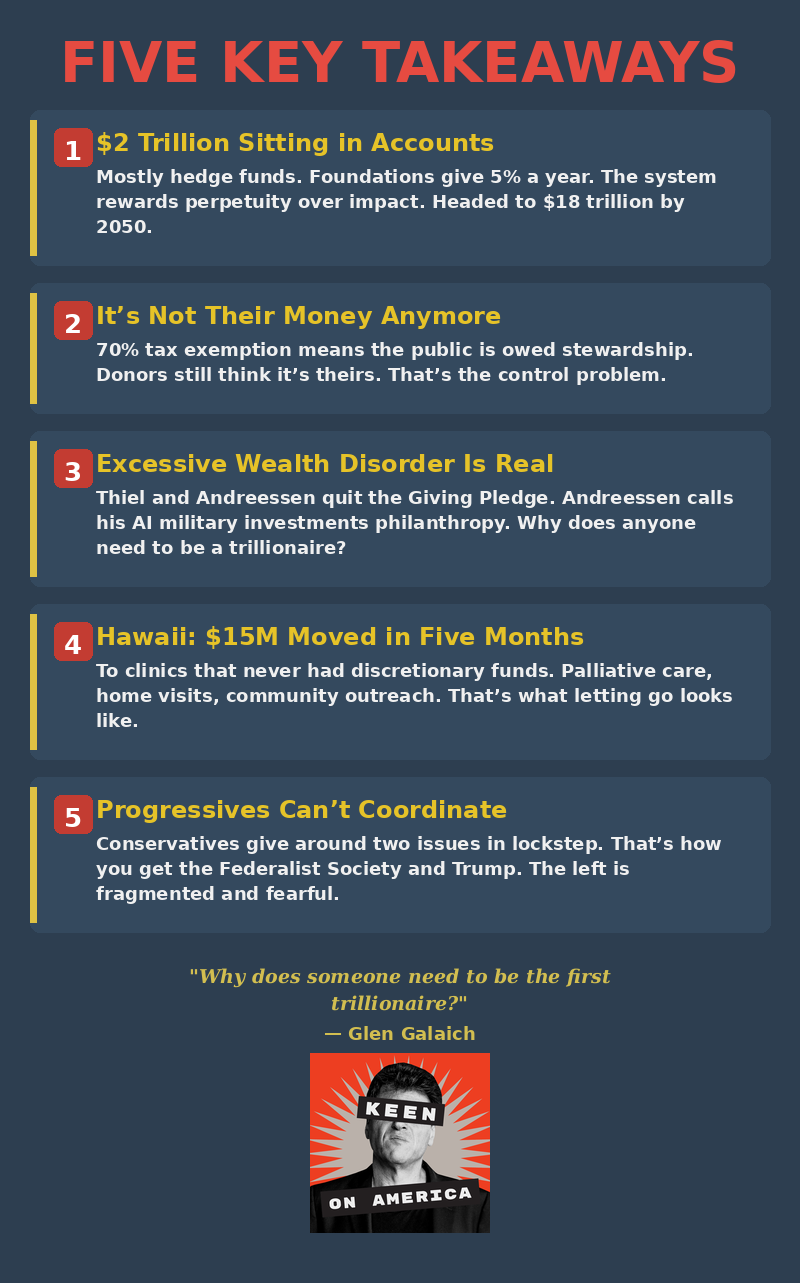
“Why does someone need to be the first trillionaire? The damage it’s doing just to get to that level is extreme.” — Glen Galaich
Excessive wealth disorder. It sounds like a disease — which, at least according to Glen Galaich — CEO of the Stupski Foundation and author of Control: Why Big Giving Falls Short, it is. There’s $2 trillion sitting in American charitable accounts Galaich says, mostly invested in hedge funds and real estate. Foundations are legally required to distribute only 5% a year — the bare minimum — and invest the remaining 95% to ensure they can make that back and live forever. The system rewards perpetuity over impact. The money is stuck — like most other things in America. And this philanthropic wealth is predicted to grow to $18 trillion by 2050 — twice the size of the annual federal budget. A truly excessive wealth disorder.
Galaich wants to unstick the system. When a donor puts money in a private foundation, they receive up to a 70% tax exemption. The public is forgoing taxation in return for public stewardship. But donors still think it’s their money. That’s Galaich’s Control problem. Carnegie pioneered this idea that the wealthy know best how to distribute their wealth. The Sacklers perfected its dark arts. Bill Gates sits somewhere in between. While billionaires like Peter Thiel and Marc Andreessen reject it entirely.
Galaich’s own foundation is giving up control — returning all its resources to communities by 2029. In Hawaii, he gave $15 million to people who actually lived there. They moved all of it within five months to health clinics on neighbouring islands that had never had discretionary money. His deeper frustration is with progressive philanthropy’s failure to coordinate. Conservative donors give around two issues — free markets and liberty — in coordinated fashion. Progressive philanthropy, in contrast, is fragmented, fearful, and obstinately sitting on its capital. There’s a new institute in the Bay Area called the Excessive Wealth Disorder Institute. Yes, Dr Galaich’s disease is real. And so is his cure.