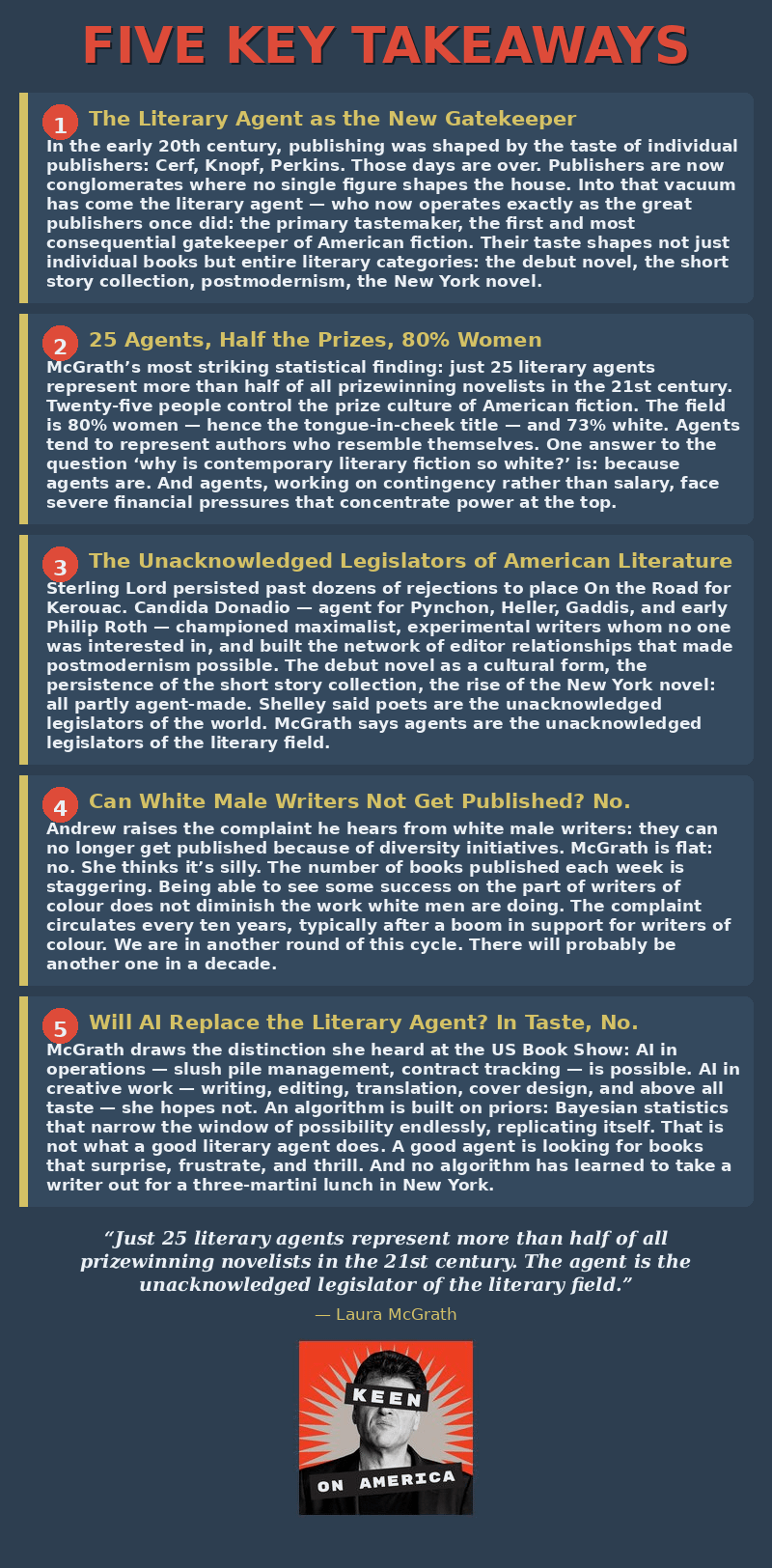
“Just 25 literary agents represent more than half of all prizewinning novelists in the 21st century. The agent is the unacknowledged legislator of the literary field.” — Laura McGrath
We think of publishers and editors as the ultimate tastemakers. As those godlike gatekeepers controlling what we read. But if you’re looking for literary gods, Laura McGrath argues, then you need to look at literary agents rather than publishers or editors. Her ten-year project, Middlemen: Literary Agents and the Making of American Fiction, is the first serious scholarly account of the literary agent’s astonishingly powerful role in shaping what America reads. Except, of course, the Middlemen are actually Middlewomen — since 80% of literary agents are women.
The numbers are striking. Just 25 literary agents represent more than half of all prizewinning novelists in the 21st century. McGrath interviewed 75 of them over ten years. Shelley called poets the unacknowledged legislators of the world. McGrath’s agents are the unacknowledged legislators of the literary field. They shaped postmodernism (Candida Donadio and Pynchon, Heller, Gaddis). They launched the debut novel as a literary form. They made the short story collection viable. And 25 of them control more than half of the prizes.
So will AI replace the agent? In operations, perhaps, McGrath acknowledges — the slush pile is overwhelming and smart machine assistance is welcome. But in creative work — in the business of writing, editing, translation, cover design, and above all taste — she thinks not. No algorithm will ever learn the Catch-22 of publishing — separating the Thomas Pynchon or Joseph Heller from all the human slop. And no bot (male or female) is ever going to host a three-martini lunch in Manhattan.