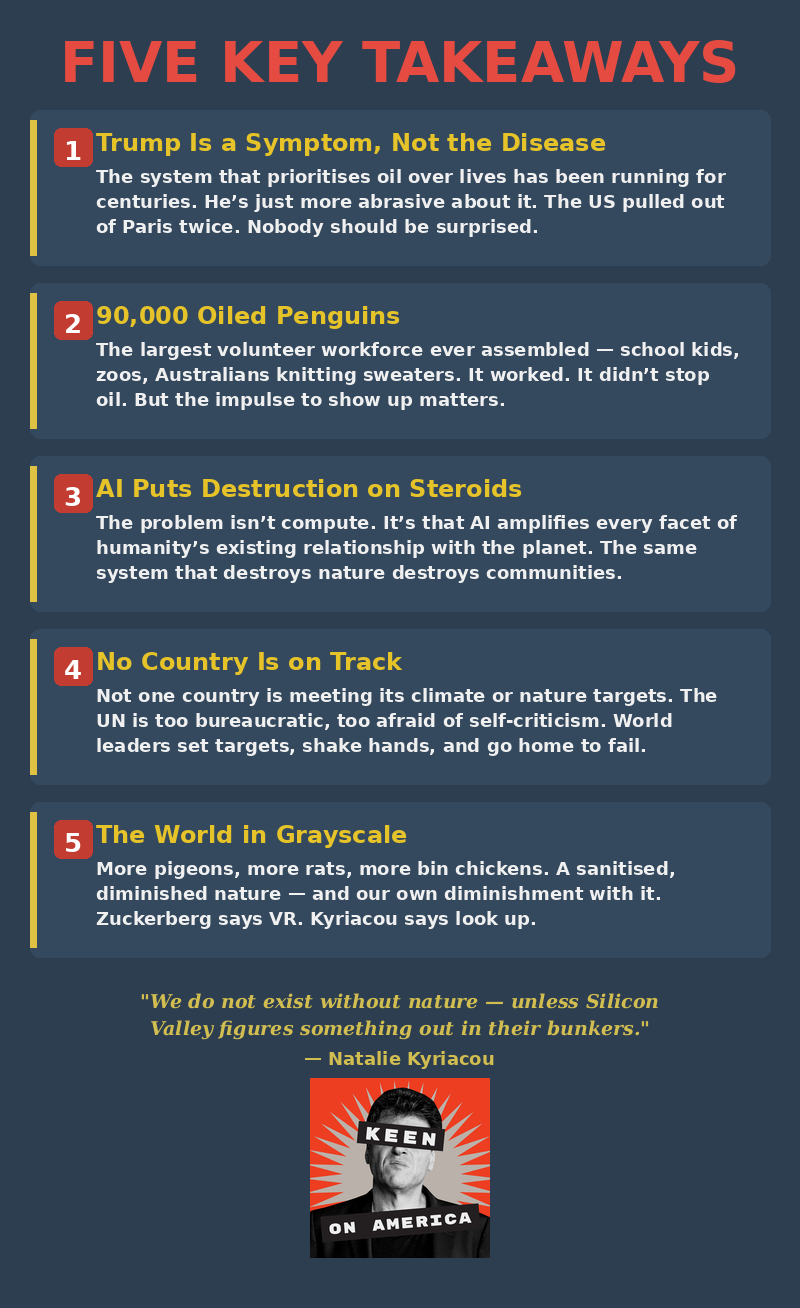
“We do not exist without nature — unless Silicon Valley figures something out in their bunkers.” — Natalie Kyriacou
Forget the Middle East for a moment. Or rather, don’t — because today’s petroleum war is an environmental catastrophe, perhaps even an ecocide. Militaries are the largest source of emissions on the planet. Trump uses Iran’s oil fields as a bargaining chip while assassinating its leaders, as if the price of petroleum is more important than human life (which it clearly is to him). Natalie Kyriacou, an Australian environmentalist and author of Nature’s Last Dance, isn’t surprised. Trump, she says, is the symptom rather than the disease. His rotten system of prioritising oil over human lives has been ruining the planet now for over a century. He’s just less polite about it.
Nature’s Last Dance is made up of what Kyriacou calls “tales of wonder” in our age of extinction. It tells the story, for example, of a 2000 oil spill off South Africa that threatened 90,000 African penguins and triggered the largest volunteer workforce ever assembled. Zoos, NGOs, school kids on bikes, Australians knitting sweaters all conspired to save the oiled penguins. It worked. At least in terms of those 90,000 penguins.
But did it change anything structurally? Perhaps not. But she’s arguing that the impulse to show up matters, that community is the unit of change, and that falling in love with the wonder of nature is the precondition for fighting for it. She presents forgiving Australian surfers who’ve been attacked by sharks now fighting to protect them. And she imagines birdwatching as a form of quiet rebellion.
But what does the world look like if this does, indeed, turn out to be nature’s last dance? Kyriacou’s answer is a kind of natural horror movie. A Hitchcockian David Attenborough movie: more pigeons, more rats and more “bin chickens” — Australia’s ibis, a bird that thrives in urban garbage. Nature’s revenge. So if we all don’t take up birdwatching, Kyriacou warns, we will all end up in The Birds.