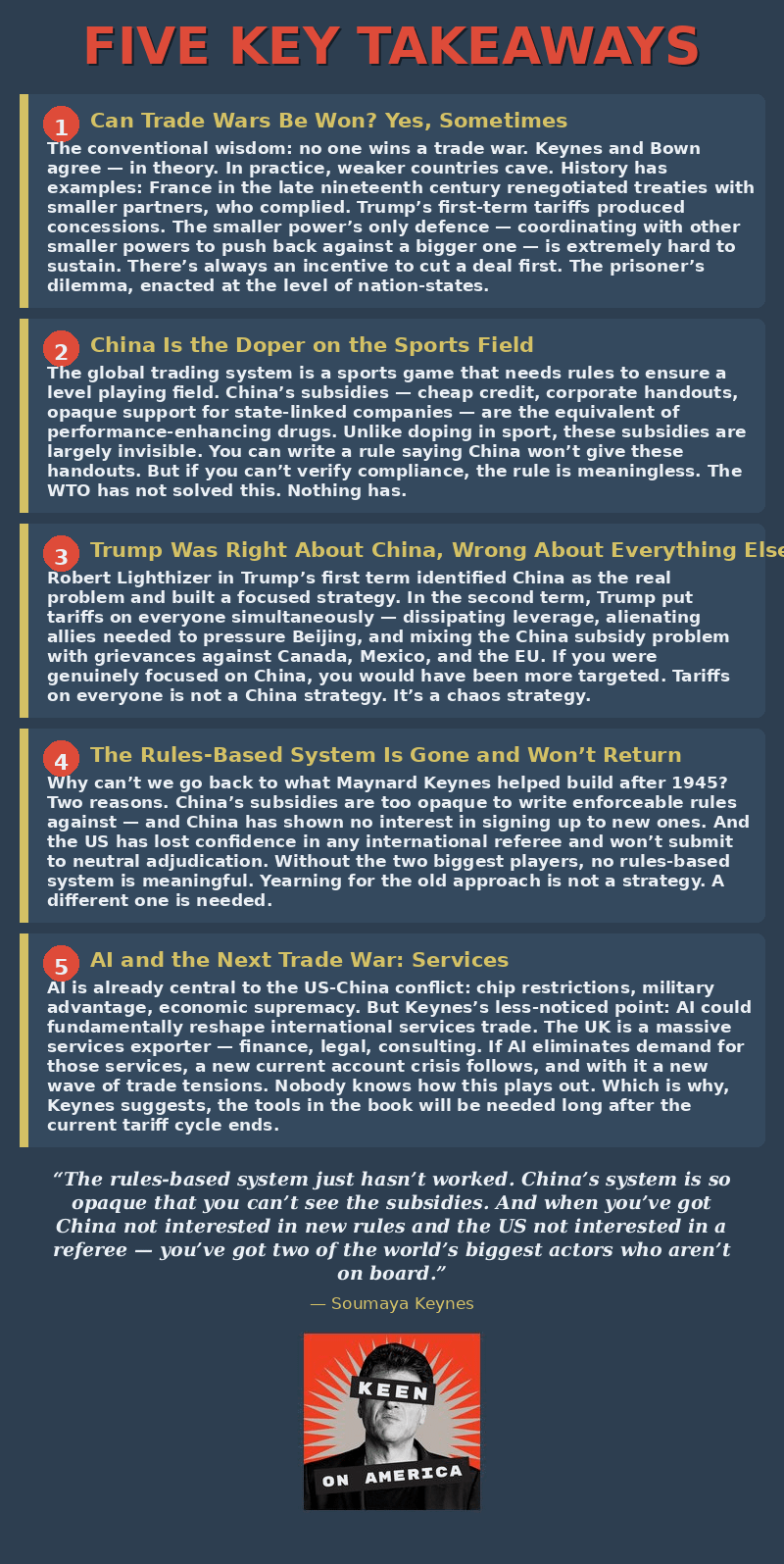
“The rules-based system just hasn’t worked. China’s system is so opaque that you can’t see the subsidies. And when you’ve got China not interested in new rules and the US not interested in a referee, you’ve got two of the world’s biggest actors who aren’t on board.” — Soumaya Keynes
It would have been nice to get John Maynard Keynes on the show to get his critique of Trump’s trade war. But in the long run, we’re all dead — even old Maynard. So instead, we found his great-great-niece, Soumaya Keynes — Financial Times columnist and co-author of How to Win a Trade War: An Optimistic Guide to an Anxious Global Economy.
Having already appeared on Jon Stewart this week, Soumaya has a bit of Keynesian star quality about her. But she’s also a first-rate economist. Her thesis is that the old rules-based trading system that her great-great-uncle helped design after World War II is gone. And it ain’t coming back. China’s subsidies are so opaque that rules can’t be written to constrain them, let alone enforced. The US is no longer willing to submit to a referee. Without the two biggest players, no rules-based system is meaningful.
So — now what? Keynes says we must think like a trade warrior. Donald Trump should leverage the tools available — but use them strategically. Trump’s error in his second term was not being tough on China while being too tough on everyone else, especially allies like Canada and Mexico.
Soumaya Keynes’ most contemporary idea might be her most Keynesian one. John Maynard Keynes proposed penalties for countries running large trade surpluses as well as those running deficits — recognising that global imbalances are a two-sided problem. That idea didn’t make it into the 1944 Bretton Woods agreement. Eighty years later, in equally anxious economic times, his optimistic great-great-niece is reviving it.