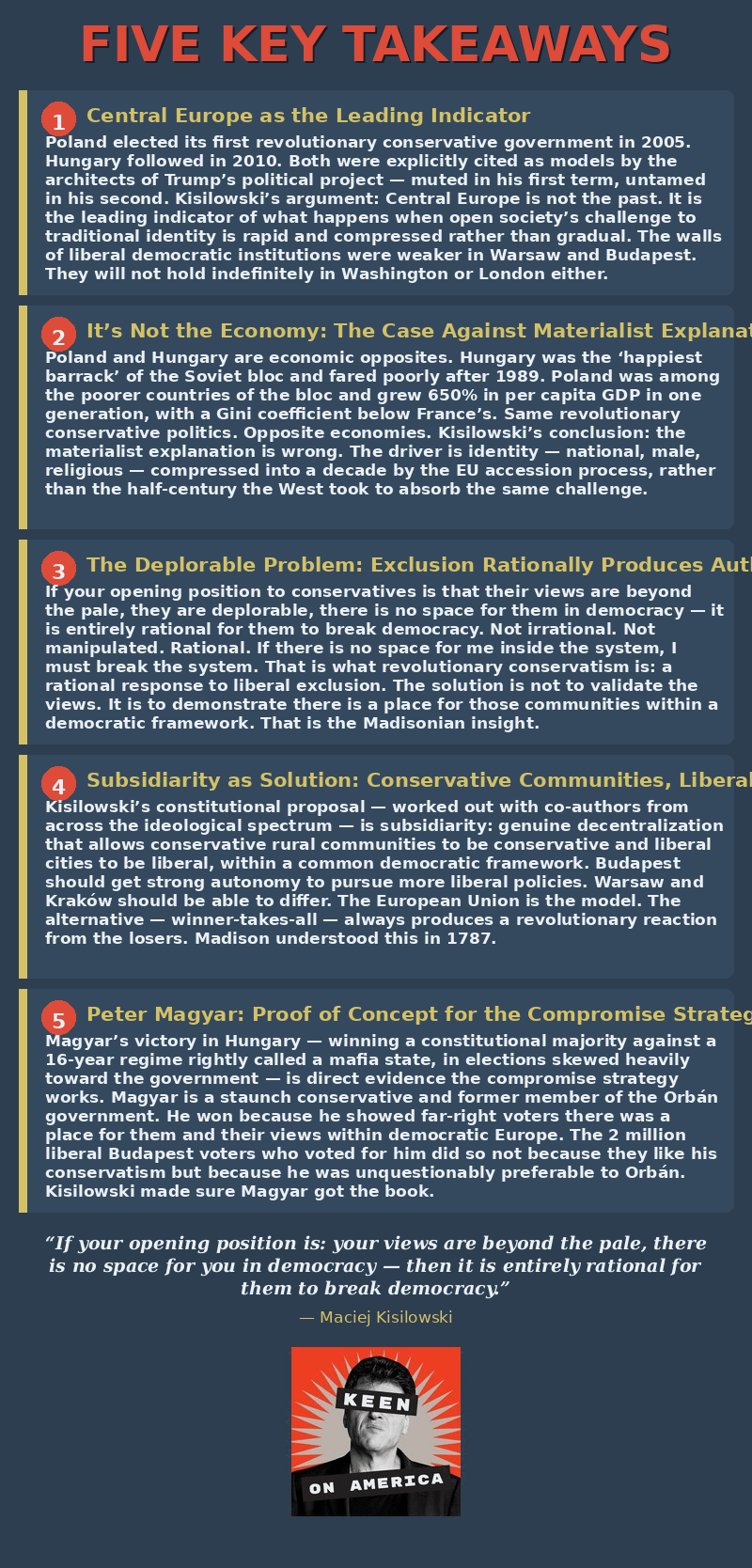
“If your opening position is: your views are beyond the pale, you are deplorable, there is no space for you in democracy — then how on earth do we expect anything other than revolutionary conservatism as a response?” — Maciej Kisilowski
For Americans concerned about the fragility of their democracy, Poland offers some reassuring news. Having experienced its own illiberal blip, democracy in Poland now seems amongst the healthiest in Eastern Europe. So what does a democracy only created in 1989 teach America as the old republic braces for its surreal semiquincentennial celebration?
The Vienna-based constitutional scholar Maciej Kisilowski is the author of Let’s Agree on Poland: A Case Study in Strategic Constitutional Design. In this bestselling 2025 book, Kisilowski argues that Poland is a map of where other Western democracies could go. If they choose to.
Poland elected its first illiberal conservative government in 2005. Hungary followed in 2010. Both explicitly served as models for Donald Trump — relatively tamed in his first term, unshackled in his second. Like the United States, Poland is a relatively rich country with per capita GDP growing an astonishing 650% in a single generation. So, Kisilowski argues, the conventional argument that Poland embraced illiberalism in response to economic hardship is mostly wrong. Instead, what triggered illiberalism in Poland was culture, particularly the compressed, accelerated challenge to traditional identity — national, male, religious — that EU accession triggered in Central Europe.
Kisilowski, who teaches at Central European University, might have entitled his book Let’s Agree to Disagree. Poland’s solution to this cultural crisis of identity is what Kisilowski calls “subsidiarity” — genuine decentralisation that allows both conservative communities to remain traditional and liberal cities to become progressive, all within a common democratic framework. He warns both the left and the right that if you tell people their views are somehow foreign, it’s entirely rational for them to want to smash their “foreign” democracy.
This is the Polish model of a viable 21st century democracy. Ironically, it’s a Madisonian warning about the dangers of faction. The “deplorable” gambit always backfires. Péter Magyar’s remarkable victory in Hungary — a staunch conservative ending Orbán’s 16-year mafia-style illiberal chapter — offers the Hungarian model of Kisilowski’s argument. So this July 4, worried Americans might read Let’s Agree on Poland. Or reread James Madison.