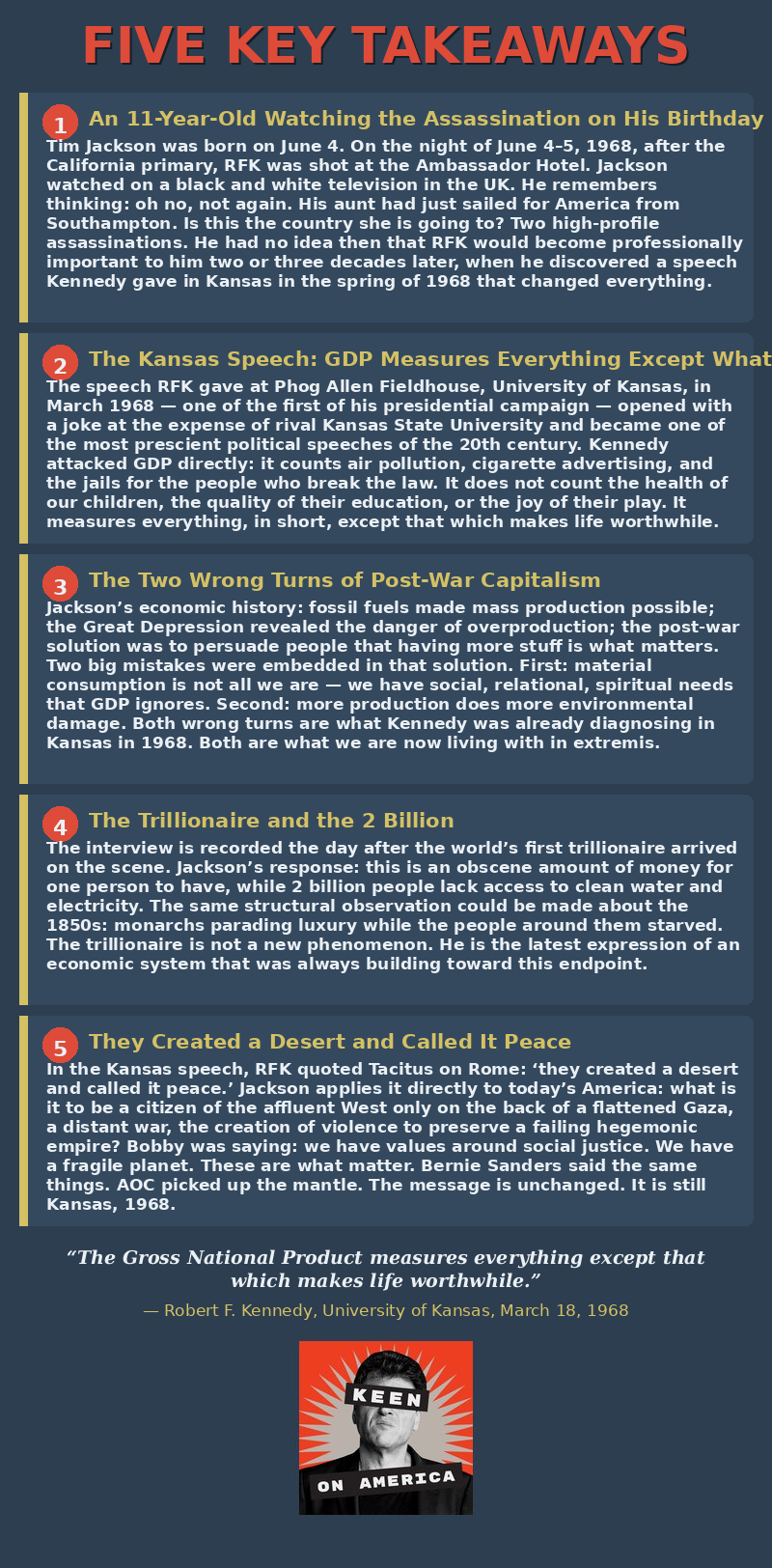
“The Gross National Product measures everything except that which makes life worthwhile.” — Robert F. Kennedy, University of Kansas, March 18, 1968
It is June 5, 1968. An eleven-year-old English boy is watching the assassination of Bobby Kennedy on his black and white television. That little boy is Tim Jackson — now one of Britain’s most influential critics of capitalism. He had no idea then that RFK would change his life. It happened years later, when Jackson discovered a speech Kennedy gave in Kansas in the spring of 1968. It was a speech that changed the way Tim Jackson thought about economics.
The March 1968 speech, one of the first of RFK’s presidential campaign, was delivered at Phog Allen Fieldhouse, University of Kansas. It opened with a joke at the expense of rival Kansas State University. Then Bobby turned deadly serious. For the first time (at least for a Presidential candidate), he attacked the very idea of the Gross National Product itself. RFK argued that GDP quantifies all the worst stuff including air pollution, cigarette advertising and jails. But it doesn’t measure the health of our children, the quality of their education, or the joy of their play. It quantifies everything except that which makes life worthwhile. Then fetishizes the data. Worse than wrong, Bobby Kennedy suggested, GDP makes data evil.
For Jackson, who has spent his career mulling over the idea of economic growth, RFK’s Phog Allen Fieldhouse speech came as a revelation. Indeed much of his later thinking, including his 2021 award-winning book Post Growth: Life After Capitalism, is indebted to this March 1968 speech. Almost sixty years later, in our ever-more-quantifiable age of ubiquitous data-centers, it’s a speech that appears uncannily prescient. Both Tim Jackson and Bobby Kennedy are right to remind us that there is an alternative to quantifying progress. There is, indeed, life after GDP. And it can’t be measured.